What Documents Do I Need to Sell a Home in Wisconsin
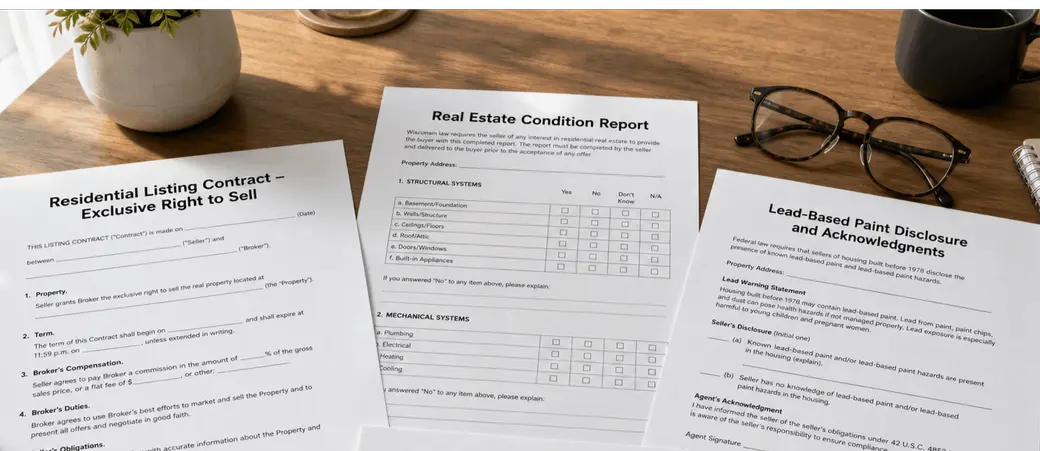
Quick answer: Selling a home in Wisconsin takes three groups of documents. First, records that prove you own the property and describe it: the deed, your tax bill, mortgage and payoff information, and a survey if you have one. Second, the required disclosures, mainly the Real Estate Condition Report, plus lead-paint disclosure and any condo or well-and-septic records. Third, the transaction paperwork: the WB listing and offer forms your agent provides, then the deed, transfer return, and settlement statement your title company prepares at closing.
Most of these you gather. Some your agent provides. A few get prepared for you at closing. Here's the full checklist, in the order you'll actually need them.
We're licensed real estate agents, not attorneys, so treat this as general information and bring legal questions to a real estate attorney.
Start gathering these before you list
These are the ownership and property records only you can pull together. Getting them in a folder early keeps the sale moving later.
-
The current deed to your home
-
Your most recent property tax bill
-
Your mortgage statement, plus details on any home equity line, second loan, or lien, so a payoff can be ordered
-
A survey and plat map, if you have them
-
Any prior title insurance policy or abstract you received when you bought
-
Homeowners insurance information, since claim history can come up
You don't need to create the deed that transfers the home to your buyer. The title company or closing attorney prepares that later. What you're doing now is proving what you own and flagging anything attached to the title.
The disclosures Wisconsin requires
-
Real Estate Condition Report. Under , most sellers of homes with four or fewer units must give the buyer a completed report within 10 days of accepting an offer, and the buyer can back out if they don't get it on time. Working through it early is the smart move. See .
-
Lead-based paint disclosure. For any home built before 1978, federal law requires a lead-paint disclosure and the EPA pamphlet.
-
Condo documents. If you're selling a condominium, buyers will need the association documents: declaration, bylaws, rules, budget, assessments, and a contact for the association.
-
Well and septic records. For a home on a private well or septic system, gather the water test and the septic inspection and pumping records, plus any shared-well agreement.
One note on the condition report: Wisconsin agents can't tell you whether a given item legally counts as a "defect." That's a question for your attorney.
The listing and offer forms
Wisconsin uses standardized, state-approved contract forms, and your agent pulls the current versions from the .
-
WB-1 Residential Listing Contract (Exclusive Right to Sell). You sign this to list. It sets your price, the term, the compensation, and how the home is marketed.
-
WB-11 Residential Offer to Purchase. The buyer submits this. You review it, then accept, counter, or decline. A condo sale uses the WB-14, and vacant land uses the WB-13.
-
Amendments and counter-offers. Changes to a deal ride on forms like the WB-40 amendment.
-
Agency disclosure. The document that explains who each agent represents.
Worth knowing: the accepted offer, not the listing or the marketing photos, controls what's included in the sale. That's why we're careful about fixtures and personal property in the WB-11.
Records buyers will ask to see
None of these are legally required, but having them ready builds buyer confidence and protects your price.
-
Permits and receipts for improvements: roof, HVAC, additions, electrical work
-
Warranties and manuals for systems and appliances
-
Recent utility bills, so buyers can gauge heating and cooling costs
-
Association dues, rules, and budget for any HOA or lake-access community
-
Well water test and septic records on private systems
-
Pier or slip permits and shoreland-zoning information for lakefront and lake-access homes
-
Lease agreements if the home is tenant-occupied
-
Any home warranty you plan to offer the buyer
Gathering and documenting these while you prep the home is covered in the .
What gets signed at closing
The title company or closing attorney prepares most of the closing documents. You bring a government-issued ID and sign.
-
The deed conveying the home to the buyer, usually a warranty deed
-
The Wisconsin Real Estate Transfer Return, filed electronically with the Department of Revenue, where the is paid
-
The settlement statement, which shows your proceeds line by line
-
Your mortgage payoff and satisfaction
-
The owner's title insurance policy, since the seller provides title evidence under the standard offer
-
A bill of sale for any personal property included in the deal
-
Keys, garage remotes, access codes, and warranties for the buyer
For how those closing lines add up, see .
Selling on behalf of someone else, or from out of state
Some sales need extra paperwork before they can close.
-
Estate or inherited home: the court document appointing you (such as letters testamentary), a death certificate, and a personal representative's deed. The condition report may not apply if you never lived in the home.
-
Trust-owned home: a trust certification showing your authority as trustee.
-
Divorce: the judgment or marital settlement terms that direct the sale.
-
Power of attorney: a valid POA if someone will sign for you.
-
Out-of-state owner: a mail-away closing and remote notarization can handle the signing.
These situations have real legal detail, so loop in a real estate attorney early. Our full process is in , and we can point you to the right specialist for estate, trust, or remote sales.
How Kim and Joel keep the paperwork on track
We provide and prepare the WB forms, help you assemble the ownership and disclosure records, coordinate with the title company on the deed and transfer return, and flag any estate, trust, or out-of-state items early so nothing stalls the closing.
and we'll build you a document checklist for your specific property.
Frequently asked questions
What documents do I need to sell a house in Wisconsin?
Three groups: ownership records (deed, tax bill, mortgage and payoff details, survey), required disclosures (the Real Estate Condition Report, lead-paint disclosure, and any condo or well-and-septic records), and transaction paperwork (the WB listing and offer forms, then the deed, transfer return, and settlement statement handled at closing).
What is the Real Estate Condition Report, and do I have to provide it?
It's the disclosure form required under Chapter 709 of the Wisconsin Statutes. Most sellers of homes with four or fewer units must give the buyer a completed report within 10 days of accepting an offer. If the buyer doesn't receive it on time, they can rescind the contract. Some sellers, such as certain court-appointed fiduciaries who never lived in the home, are exempt.
Do I need a lawyer to sell a home in Wisconsin?
Not for a standard sale. Your agent provides the state-approved contract forms, and the title company handles the deed and closing documents. An attorney is a good idea for estate, trust, or divorce sales, out-of-state signings, or any deal with a legal wrinkle.
Who prepares the deed and the transfer documents?
The title company or closing attorney prepares the deed and files the Wisconsin Real Estate Transfer Return at closing. You review and sign them. You don't draft these yourself.
What documents do buyers usually ask for?
Permits and receipts for improvements, warranties and manuals, recent utility bills, association documents, well and septic records, and pier or shoreland permits for lake homes. They aren't legally required, but they speed up the deal and support your price.
What extra documents do I need for an inherited or trust-owned home?
For an estate, expect to provide the court appointment (such as letters testamentary), a death certificate, and a personal representative's deed. For a trust, a trust certification shows your authority. These sales have added legal steps, so involve a real estate attorney early.
Get a document checklist for your sale
Thinking about selling in Lake Geneva, Williams Bay, Fontana, Geneva National, Delavan, Elkhorn, or anywhere in Walworth County?
Categories
- All Blogs (210)
- Burlington Buyers Guide (1)
- Burlington Relocation Guide (3)
- Burlington Sellers Guide (1)
- Delavan Buyers Guide (1)
- Delavan Lake Sellers Guide (1)
- Delavan Real Estate Market Update (1)
- Delavan Relocation Guide (1)
- Delavan Sellers Guide (1)
- East Troy Buyers Guide (1)
- East Troy Relocation Guide (1)
- Elkhorn Buyers Guide (1)
- Elkhorn Relocation Guide (1)
- Elkhorn Sellers Guide (1)
- Fontana (13)
- Fontana Buyers Guide (1)
- Fontana Sellers Guide (1)
- Fontana WI Relocation Guide (2)
- Geneva National (5)
- Lake Geneva (29)
- Lake Geneva & The Southern Lakes Market Report (1)
- Lake Geneva Area Homes (10)
- Lake Geneva Buyers Guide (8)
- Lake Geneva Real Estate Market Update (6)
- Lake Geneva Sellers Guides (44)
- Lauderdale Lakes (2)
- Twin Lakes Buyers Guide (1)
- Twin Lakes Relocation Guide (3)
- Twin Lakes Sellers Guide (1)
- Walworth Buyers Guide (1)
- Walworth County Market Updates (5)
- Walworth County Seller Guides (6)
- Walworth Relocation Guide (3)
- Walworth Sellers Guide (1)
- Whats Happening at the Lake (30)
- Whitewater Buyers Guide (1)
- Whitewater Relocation Guide (3)
- Whitewater Sellers Guide (1)
- Williams Bay (9)
- Williams Bay Real Estate Market Update (1)
- Williams Bay Relocation Guide (3)
- Williams Bay Sellers Guide (3)
Recent Posts