How to Handle Multiple Offers on a Lake Geneva Home
Quick answer: A Wisconsin seller holding several offers has 4 moves: accept one, counter one on the WB-44 Counter-Offer, counter several at once on the WB-46 Multiple Counter-Proposal, or set a highest-and-best deadline. Which move is right depends on how far apart the offers are on price, which one carries the least risk of falling apart, and what kind of property is being sold. A condominium, a golf-community townhome, and an inherited property each change the answer.
Competing offers are the outcome every seller wants and the one most sellers are least prepared for. The window is short and the paperwork is unforgiving. Here is how we work through it, on both sides of the table.
When a listing draws more than one offer
It happens when a property is priced at or slightly below what the comparable sales support, is in showable condition on day 1, and sits in a price band where inventory is thin.
Timing does most of the work. In Joel's July 9, 2026 MLS pull covering Lake Geneva, Fontana, and Williams Bay single-family homes, roughly 60% of sold and pending listings went under contract within 30 days, against a median of 40 days on market. Properties that draw competing offers sit at the very front of that curve, usually inside the first 10 days.
Segment matters as much as price. In-town single-family homes and near the area median see competing offers most often.
Launch weekend matters more than people expect. A first weekend that lands against a big draw on the puts more traffic through the door in 48 hours than the following 2 weeks combined.
None of this happens by accident. It follows from rather than pricing high and correcting later.
Your 4 responses, and what each one costs you
Wisconsin has a form for each path. All of them are published by the state at the .
| Response | Form | What it does | The tradeoff |
|---|---|---|---|
| Accept one offer | WB-11, or WB-14 for a condominium | Signs and delivers the buyer's offer as written. Contract formed | Fastest and cleanest. You give up any chance to improve terms |
| Counter one offer | WB-44 Counter-Offer | Rejects that offer and proposes new terms to a single buyer | You negotiate with one party while the others wait, and waiting buyers write elsewhere |
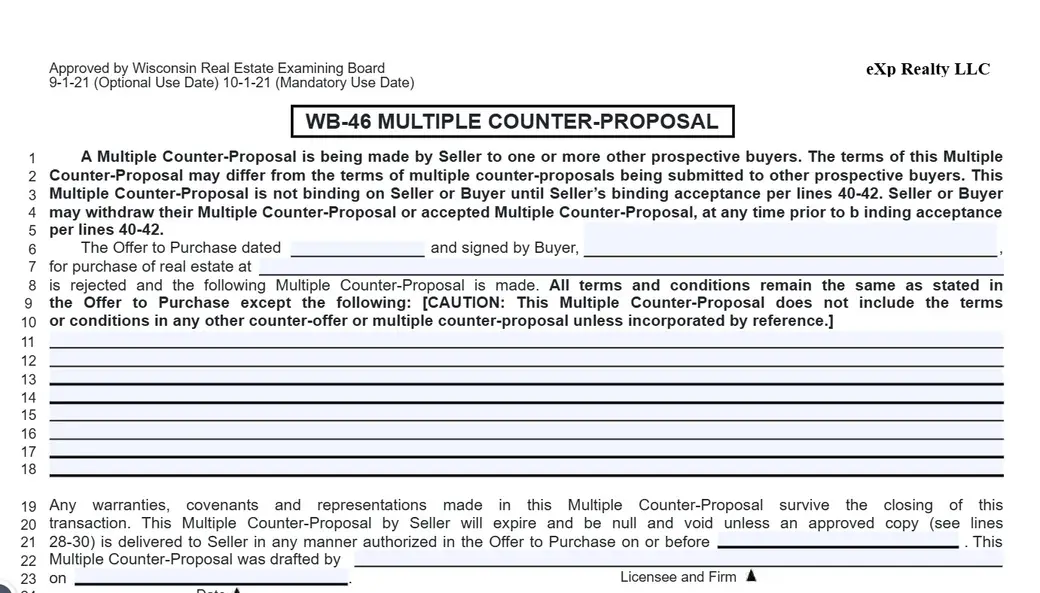
| Counter several at once | WB-46 Multiple Counter-Proposal | Sends terms to more than one buyer without binding you to the first one who signs | Keeps every buyer engaged. You still accept in writing afterward, so it moves slower |
| Call for highest and best | No separate state form | Sets a deadline for every buyer to submit their strongest terms | Full information. Can also thin the field, since some buyers decline to bid against themselves |
The WB-46 is the one sellers rarely know exists. It lets you put terms in front of 3 buyers on Sunday morning without the risk of accidentally forming 3 contracts by Sunday night.
What to read after the price
Price is 1 of at least 8 things on the table. The rest decide whether the price survives to closing.
| Term | What to look at | Why it matters to you |
|---|---|---|
| Financing | Cash, conventional, FHA, VA, second-home, or a bridge on the buyer's current property | Determines who else has to say yes before this closes |
| Lender letter | Preapproval versus a verified underwritten approval | A preapproval is a starting point. An underwritten approval has already had the file reviewed |
| Appraisal language | Contingency intact, capped, or waived | The term most likely to reopen a negotiated price |
| Inspection | Full inspection, limited scope, or a walkthrough for information only | Sets how much of the price can be renegotiated later |
| Closing date | Days to close, and whether it fits your next move | A perfect price on the wrong date can cost you a rate lock or a rental |
| Earnest money | Amount and when it is deposited | The buyer's own measure of how serious they are |
| Occupancy | Whether you need days after closing to move out | Real money if you have a second closing to coordinate |
| Personal property | Furnishings, boat lift, pier sections, patio furniture, shop equipment | On a vacation home or a country property this list is often the quiet difference between 2 offers |
An offer contingent on the sale of the buyer's current property needs its own read. A buyer whose house is already under contract with contingencies cleared is a different proposition from one whose house has not been listed yet. That works both directions, and it is the same problem covered in .
Two offers, thirteen thousand dollars apart
A worked example. The numbers are illustrative, not a real transaction.
| Offer A | Offer B | |
|---|---|---|
| Price | $625,000 | $612,000 |
| Financing | Conventional, 20% down | Cash, proof of funds attached |
| Appraisal contingency | Intact | None |
| Inspection | Full, 10 days | Full, 7 days |
| Closing | 45 days | 21 days |
| Earnest money | $10,000 | $25,000 |
Offer A is $13,000 higher and has 2 places where the price can move: the appraisal and the inspection. If the appraisal comes in at $605,000, Offer A is back on the table below Offer B, 3 weeks into the deal, with the other buyer gone.
That is the arithmetic to run before signing, and it is why matter as much on the day you review offers as on the day you set the price.
Cash is not automatically the winner either. A cash buyer with a full inspection contingency can still renegotiate or walk. What cash removes is lender risk and appraisal risk, and that is worth a real number, just not an unlimited one.
What changes by property type
| Segment | What complicates the decision | What to check in each offer |
|---|---|---|
| In-town single family | The segment most likely to see competing offers | Financing type, closing date, occupancy after closing |
| Condominium | The buyer keeps a rescission right tied to the disclosure materials | Whether documents have been delivered, and whether your declaration contains a right of first refusal |
| Golf community | Transfer fees, capital contributions | Whether the buyer has read the association documents and priced the dues and capital contributions |
| Vacation or second home | Second-home financing terms, and a long personal property list | Furnishings list, seller access after closing, rental restrictions |
| Country and acreage | Well, septic, survey, and easements extend diligence | Inspection scope, and whether the lender uses an appraiser with rural experience |
| Lakefront and lake access | Appraisal risk and water rights | Appraisal contingency language, and exactly what conveys on the water |
| Inherited or probate | Multiple signers, and sometimes court oversight | Closing date flexibility, and the buyer's tolerance for limited condition disclosure |
Two of these deserve more than a table row.
Condominiums. An accepted condominium offer is less firm than an accepted house offer. Under , a buyer holds a rescission right tied to delivery of the condominium disclosure materials, and 703.33 sets that out. Practically, the clock on a competing-offer decision does not really stop until those documents are delivered and the rescission period runs. Have the association package assembled before you list, not after.
Golf communities. At Geneva National and Abbey Springs, the offer that looks strongest can be the one from a buyer who has not yet read the association documents. Transfer fees, capital contributions, all land after acceptance, and a surprised buyer renegotiates. Our guide to covers what that package should contain.
Vacation and second homes turn on the personal property list, covered in . Waterfront turns on what the recorded documents grant, covered in .
Multiple offers on an inherited or probate property
Estate sales draw competing offers more often than people expect, because they frequently come to market priced to move and in a condition band with thin inventory.
Three things change.
Who signs. A personal representative or trustee signs, and the authority to do so comes from the court appointment or the trust document. If several heirs must consent, get that agreement in place before offers arrive rather than during a 24-hour response window.
What you disclose. Certain court-appointed fiduciaries, including a personal representative who never occupied the property, are excluded from the Real Estate Condition Report requirement. That is a real difference, and it changes how buyers price risk. Expect more inspection-driven renegotiation and weigh inspection terms accordingly.
How fast you can move. Court oversight, title questions, and pending estate matters can all outlast a buyer's patience. A buyer offering a flexible closing date is worth more here than in almost any other segment.
Legal authority, tax consequences, and heir disputes belong with the estate attorney and the accountant. The real estate side is covered in .
Calling for highest and best
Highest and best works when you have 3 or more genuinely competitive offers and the property has been live long enough that every interested buyer has seen it. Give a firm deadline, tell every agent the same thing at the same time, and say what you want addressed: price, financing, appraisal language, and closing date.
It works less well with 2 offers, or on day 3. Some buyers read an early call for highest and best as a sign the property was underpriced on purpose, and they withdraw instead of raising. You are also not obligated to take the highest number that comes back. The call asks for terms, and the decision stays yours.
If you are the buyer in this situation
Full-service means we sit on this side of the table too, and the moves are different.
Get underwritten rather than preapproved. A verified underwritten approval is the cheapest advantage available to a buyer, and it separates you from 3 other letters that all look alike.
Then look for the terms you can move that are not price. Earnest money. A shorter inspection window with the full scope preserved. A closing date built around the seller's next move. On a vacation property, flexibility on the furnishings list.
Read the property type before you write. On a condominium, ask for the disclosure materials up front. In a golf community, price the dues and the transfer costs before you set your number. On an estate sale, offer the flexible date.
If an escalation clause is on the table, have your attorney draft it, because the wording controls how the price is actually determined after acceptance.
And if you come in second, take the backup position. Inspection and financing contingencies fail more often than anyone expects. You can while you wait.
The fair housing line in a multiple-offer decision
A seller chooses among offers. A seller does not choose among buyers.
That distinction matters most with the personal letter, sometimes called a buyer love letter. These letters routinely contain information about race, religion, national origin, disability, or whether the household includes children. Wisconsin adds more protected classes on top of the federal list including age and marital status.
Once that information is in front of a seller, any decision that follows can be questioned. We do not deliver these letters, and we ask buyers' agents not to send them. Every offer gets compared on its written terms.
If a buyer wants to communicate something, it belongs in the offer: a flexible closing date, a shorter inspection window, a larger earnest money deposit. Those are terms, and terms are what anyone is allowed to weigh.
Frequently asked questions
Can a Wisconsin seller counter more than one offer at the same time?
Yes. Wisconsin has a form for it, the WB-46 Multiple Counter-Proposal, approved by the Real Estate Examining Board. It sends your terms to several buyers at once and is written so that a buyer signing it does not automatically create a contract. The seller still accepts in writing afterward, which is what keeps you from being bound to 2 buyers.
Does a seller have to disclose that there are multiple offers?
No. Whether to tell buyers that other offers exist is the seller's decision, and the listing firm follows that instruction. Many sellers disclose that competing offers exist without disclosing the terms. Disclosing the actual numbers is a different choice with different consequences, and it should be a deliberate one.
Is a cash offer always better than a financed offer?
No. Cash removes lender risk and appraisal risk, which is worth real money on a property that may be difficult to appraise. Cash does not remove inspection risk, and a cash buyer can still renegotiate or walk. Ask for proof of funds dated within the last 30 days and read the contingencies before treating a cash offer as stronger.
What is different about multiple offers on a condominium?
The buyer holds a rescission right tied to delivery of the condominium disclosure materials under Wis. Stat. ch. 703, so an accepted offer is not as settled as it looks until those documents are delivered and the period runs. Some declarations also contain a right of first refusal. Assemble the association package before listing.
How do I win a multiple-offer situation as a buyer?
Get a fully underwritten approval rather than a preapproval, then compete on the terms that are not price: earnest money, a realistic closing date, inspection scope and timing, and appraisal language. Match the offer to the property type, and take the backup position if you come in second, because contingencies fail more often than people expect.
What happens with multiple offers on an inherited or probate property?
The personal representative or trustee signs, and every required heir or co-representative should be aligned before offers arrive. Certain court-appointed fiduciaries are excluded from providing a Real Estate Condition Report, so buyers price condition risk differently and inspection terms carry more weight. A buyer with a flexible closing date is usually worth more than a slightly higher number.
Talk it through before anyone signs
Kim and Joel Reyenga represent buyers and sellers across Lake Geneva, Williams Bay, Fontana, Geneva National, Abbey Springs, Delavan, Elkhorn, and the surrounding lake and country communities of southeastern Wisconsin. Luxury, lake, golf, town and country: single-family homes, condominiums, vacation and second homes, acreage, and inherited or estate-related sales. Getting to competing offers starts with the launch, which is covered in the full , and ends with a side-by-side reading of every term. Current pace and pricing sit in the .
Selling? or see how the . Buying? Bring us the property and we will read the association documents, the disclosures, and the comparable sales before you write. Either way, call or text (262) 325-9867
Categories
- All Blogs (210)
- Burlington Buyers Guide (1)
- Burlington Relocation Guide (3)
- Burlington Sellers Guide (1)
- Delavan Buyers Guide (1)
- Delavan Lake Sellers Guide (1)
- Delavan Real Estate Market Update (1)
- Delavan Relocation Guide (1)
- Delavan Sellers Guide (1)
- East Troy Buyers Guide (1)
- East Troy Relocation Guide (1)
- Elkhorn Buyers Guide (1)
- Elkhorn Relocation Guide (1)
- Elkhorn Sellers Guide (1)
- Fontana (13)
- Fontana Buyers Guide (1)
- Fontana Sellers Guide (1)
- Fontana WI Relocation Guide (2)
- Geneva National (5)
- Lake Geneva (29)
- Lake Geneva & The Southern Lakes Market Report (1)
- Lake Geneva Area Homes (10)
- Lake Geneva Buyers Guide (8)
- Lake Geneva Real Estate Market Update (6)
- Lake Geneva Sellers Guides (44)
- Lauderdale Lakes (2)
- Twin Lakes Buyers Guide (1)
- Twin Lakes Relocation Guide (3)
- Twin Lakes Sellers Guide (1)
- Walworth Buyers Guide (1)
- Walworth County Market Updates (5)
- Walworth County Seller Guides (6)
- Walworth Relocation Guide (3)
- Walworth Sellers Guide (1)
- Whats Happening at the Lake (30)
- Whitewater Buyers Guide (1)
- Whitewater Relocation Guide (3)
- Whitewater Sellers Guide (1)
- Williams Bay (9)
- Williams Bay Real Estate Market Update (1)
- Williams Bay Relocation Guide (3)
- Williams Bay Sellers Guide (3)
Recent Posts