What Are Seller Closing Costs in Walworth County, Wisconsin?
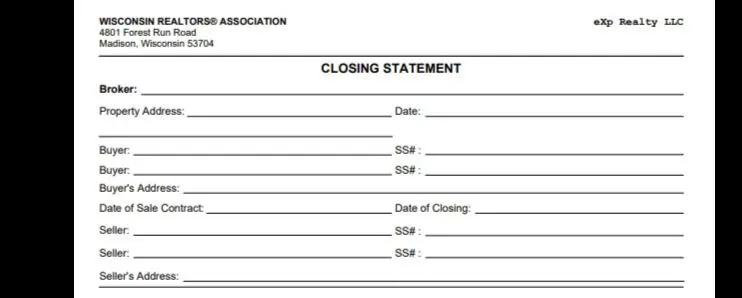
Quick answer: A Walworth County seller generally pays negotiated broker compensation, the Wisconsin real estate transfer fee of $3 per $1,000 of sale price, property-tax proration to the closing date, the payoff on any mortgage or lien, and the seller's share of title and closing charges. On a $424,000 sale the transfer fee alone is $1,272. Everything else moves with your price, your offer terms, and your property type.
Below is the itemized version, worked examples at 4 price points, and the part sellers ask about most: when each cost actually hits.
What a Walworth County seller pays
Seven line items cover almost every residential sale in this county.
| Cost | Who sets it | Negotiable |
|---|---|---|
| Broker compensation | Your listing contract | Yes, by agreement |
| Wisconsin transfer fee | State statute, $3 per $1,000 | No |
| Property-tax proration | Your closing date, using the formula in the offer | The formula is, the math is not |
| Mortgage or lien payoff | Your lender or lienholder | No |
| Title, deed, recording, closing | The offer plus the title company's fee schedule | Partly, the splits are assignable |
| Seller credits or repair concessions | Negotiation after inspection | Yes |
| Association charges | Your condo or community documents | No |
Broker compensation is set by agreement in your listing contract rather than by law, and it covers pricing, marketing, showings, negotiation, and transaction coordination. It's the largest number on most settlement statements and the one most worth understanding in detail.
The Wisconsin transfer fee, exactly
This is the one cost you can calculate to the dollar before you ever list.
Under , the fee is $3 for each $1,000 of value, or fraction of it. The grantor pays it, and the grantor is the seller, unless a statutory exemption applies. It's filed and paid through the , which the closing agent typically handles.
| Sale price | Transfer fee |
|---|---|
| $424,000 (near the Walworth County median) | $1,272 |
| $571,000 (nearer the Geneva Lake single-family median) | $1,713 |
| $1,000,000 | $3,000 |
| $1,500,000 | $4,500 |
The rate is flat, so it scales in a straight line. A Fontana lakefront sale at $2 million carries a $6,000 transfer fee, and the calculation is the same one.
When each cost actually hits
Sellers picture closing costs as a single moment at the end. The sequence is longer than that, and knowing it prevents surprises.
Before you list. Nothing appears on a settlement statement yet. Repairs, cleaning, staging, and photography come out of pocket in this window, and they're marketing costs rather than closing costs.
At offer acceptance. The proration formula gets locked in. The WB-11 Residential Offer to Purchase states exactly how property taxes will be divided, so the number that shows up months later is decided here.
Between acceptance and closing. Inspection results can produce a buyer credit or a repair agreement. Whatever you concede in that negotiation comes out of your proceeds, and it belongs on your net sheet the day you agree to it.
At closing. Everything else settles at once. Broker compensation, the transfer fee, tax proration, the loan payoff, title and recording charges, and any association items all appear on the settlement statement, and the balance wires to you.
Why your closing date changes your number
Tax proration moves with the calendar, and on a Geneva Lake property that's real money.
You cover taxes for your portion of the year up to closing. Close early in the year and you owe a small slice. Close in late fall and you're covering most of it. On a lakefront home with a five-figure annual tax bill, shifting a closing by 3 weeks can move your net by more than the transfer fee costs. Walworth County publishes its if you want to see where your parcel sits.
This is why the listing calendar and the net sheet get built at the same time. The season you list in drives your sale price, and the date you close on drives your proration, and both belong in the same conversation. See for how the calendar works here.
What changes by property type
Your property type decides whether the list above stays at 7 items or grows.
In-town and inland homes. A single-family home in Delavan, Elkhorn, Whitewater, or the city of Lake Geneva is usually the simplest closing in the county. Seven line items, no association layer, and a settlement statement that fits on one page.
Condominiums. Add association document fees, a resale certificate, any unpaid assessments, and dues prorated to closing. Condo sales run on the WB-14 form and carry a buyer rescission right tied to the disclosure materials, which is worth understanding before you accept an offer. See .
Geneva National and other association communities. Community charges, transfer fees set by the association, and sometimes a distinction between property ownership and membership that has to be sorted before closing. The covers how that community is organized, and covers the transaction side.
Lake-access and lakefront properties. Outlot associations, pier or slip transfer items, and shared-maintenance assessments can all appear. Pull the recorded documents early, because these are the items that hold up a closing when they surface late.
Whatever the type, gather the paperwork before you list rather than during the inspection period. is the checklist.
What is not a closing cost
Two things get lumped in here that don't belong on the settlement statement.
Pre-listing expenses. Repairs, cleaning, staging, and photography are money you spend to get a better price. They're real costs and they belong in your overall math, and they aren't closing costs.
Capital-gains and income taxes. These are separate, and they depend on your basis, your improvements, and any prior rental use. We're licensed real estate agents rather than tax advisers, so bring this to a CPA, particularly on a second home, a long-held property, or an inherited one. Getting the basis question answered before you list is easier than answering it in April.
Mistakes we see on closing costs
Using a percentage rule of thumb. "About 8%" is a number people repeat because it's easy, and it can be off by thousands in either direction depending on your loan balance, your association, and your closing date. Ask for real numbers.
Assuming the buyer pays the transfer fee. The statute assigns it to the grantor. In Wisconsin, that's you.
Leaving association documents until the inspection period. Resale certificates take time to produce. A condo or community sale that starts gathering documents after an offer is accepted is a sale with an avoidable delay built into it.
Treating list price as proceeds. This is the big one. The gap between the two is exactly what a net sheet exists to show, and discovering it at the closing table is the worst possible timing.
Forgetting that a credit is a cost. A $6,000 buyer credit negotiated after inspection reduces your proceeds by $6,000. It doesn't feel like a closing cost when you agree to it, and it lands like one.
Get your exact number
The reliable figure comes from a net sheet built for your property, then confirmed by the title company on the settlement statement at closing.
We build the net sheet before you list, using a for the price side and your actual loan balance, tax bill, and association items for the deduction side. That way you're choosing a list price knowing what it nets you.
Want the numbers for your address? Request a . The full walk-through of selling costs is in , and the whole listing process is in .
Frequently asked questions
What are seller closing costs in Walworth County, Wisconsin?
Generally negotiated broker compensation, the Wisconsin transfer fee of $3 per $1,000 of sale price, property-tax proration to the closing date, the payoff on any mortgage or lien, and the seller's share of title and closing charges. Condo and association properties add document fees, transfer charges, unpaid assessments, and prorated dues. Any buyer credit you agree to also reduces your proceeds.
How much is the Wisconsin transfer fee and who pays it?
It's $3 for each $1,000 of value, or fraction of it, and Wis. Stat. section 77.22 assigns it to the grantor, meaning the seller, unless an exemption applies. On a $424,000 sale that's $1,272. On a $571,000 sale it's $1,713. On a $1.5 million sale it's $4,500.
When do I pay closing costs when selling a house in Wisconsin?
Most of them settle at closing, deducted from your proceeds on the settlement statement rather than paid out of pocket. The exceptions come earlier: pre-listing repairs and staging are paid as you go, and any buyer credit is agreed during the inspection period even though it lands at closing.
Does my closing date change my closing costs?
Yes, through property-tax proration. You cover taxes for your share of the year up to closing, so a later closing date means a larger proration. The offer states the formula, and on a property with a high annual tax bill, moving the closing by a few weeks can change your net noticeably.
What extra costs do condo or Geneva National sellers have?
Association properties can carry document or resale-certificate fees, association transfer charges, any unpaid assessments, and dues prorated to closing. These sit on top of the standard items, so gather the association documents and dues information before you list rather than after an offer arrives.
Are capital-gains taxes a closing cost?
No. Capital-gains and income taxes are separate from the closing-cost estimate and depend on your basis, improvements, and any prior rental use. A CPA should review your situation, particularly for a second home, a long-held property, or an inherited one.
Get your Walworth County net sheet
Selling in Lake Geneva, Williams Bay, Fontana, Geneva National, Delavan, Elkhorn, or anywhere in Walworth County?
, or call or text (262) 325-9867
Categories
- All Blogs (194)
- Delavan Buyers Guide (1)
- Delavan Lake Sellers Guide (1)
- Delavan Real Estate Market Update (1)
- Delavan Relocation Guide (1)
- Delavan Sellers Guide (1)
- Elkhorn Buyers Guide (1)
- Elkhorn Relocation Guide (1)
- Elkhorn Sellers Guide (1)
- Fontana (13)
- Fontana Buyers Guide (1)
- Fontana WI Relocation Guide (2)
- Geneva National (5)
- Lake Geneva (29)
- Lake Geneva Area Homes (10)
- Lake Geneva Buyers Guide (8)
- Lake Geneva Real Estate Market Update (6)
- Lake Geneva Sellers Guides (44)
- Lauderdale Lakes (2)
- Walworth County Market Updates (5)
- Walworth County Seller Guides (6)
- Whats Happening at the Lake (30)
- Williams Bay (9)
- Williams Bay Real Estate Market Update (1)
- Williams Bay Relocation Guide (3)
- Williams Bay Sellers Guide (3)
Recent Posts